Project at a glance
- Client: Portage Power
- Site: Chaudière Falls hydroelectric station, Ottawa, Ontario — Unit 1 replacement
- Technical partner: Andritz Hydro, turbine supplier
- CNC Mechanical scope: receiving, rigging, lifting and setting the bulb turbine
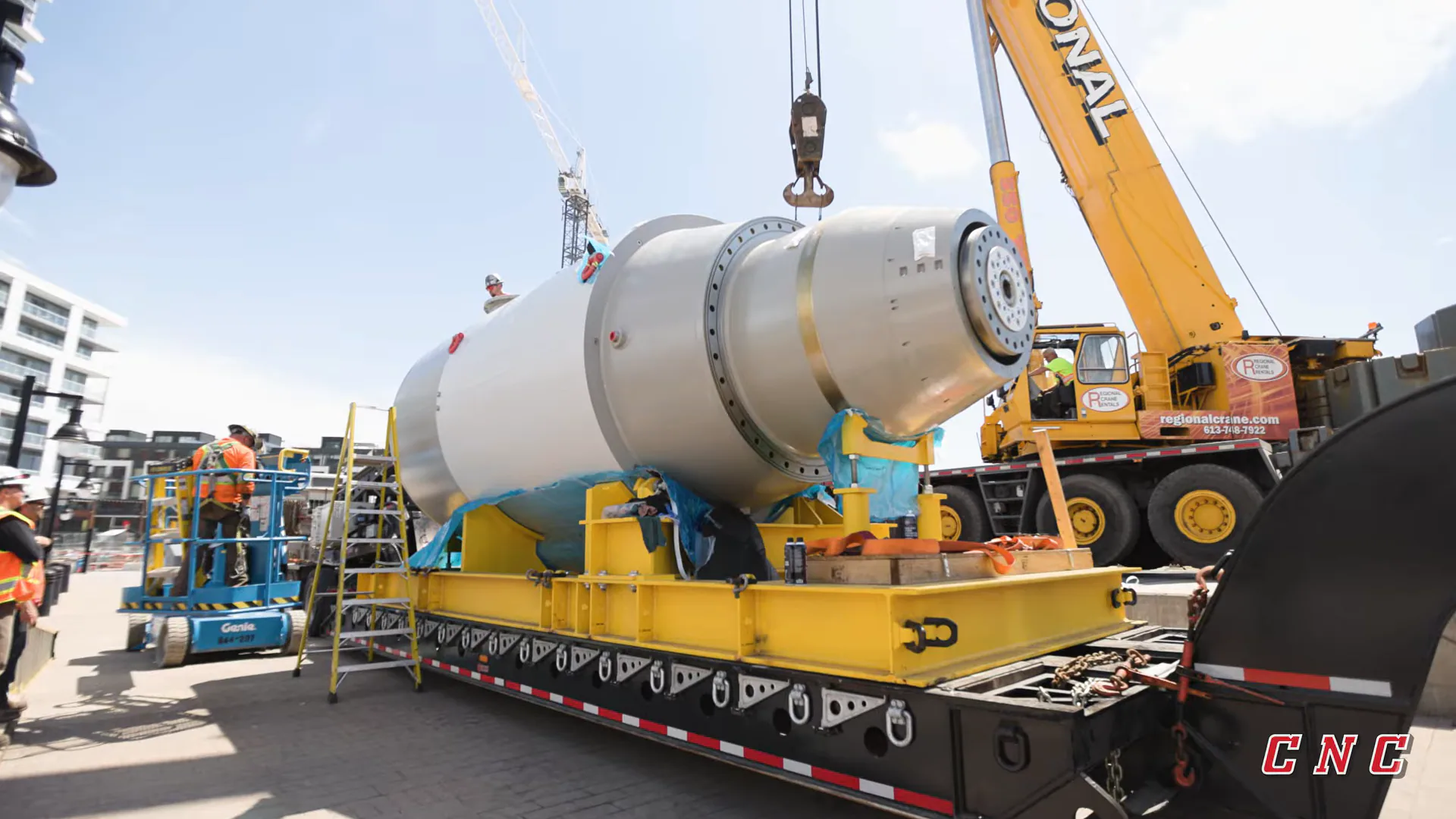
- Equipment installed: 7.5 MW bulb turbine, 136,000 lb unit
- Lifting means: 350-ton mobile crane; 150-foot, 13-axle trailer
- Rigging: four Kevlar slings rated 90,000 lb and two 30-ton chain falls
- Descent: approximately 80 feet into the intake, with less than 1/8 in clearance
- Outcome: receiving and installation completed in one day, with no incident
- Trades involved: millwright services, rotating equipment and planned heavy lifting
The challenge: less than 1/8 of an inch of clearance
A bulb turbine is installed from above, into a narrow concrete shaft. The available diameter leaves almost no margin: less than 1/8 of an inch separated the unit from the inner shaft throughout the descent. At that tolerance, a 136,000 lb turbine cannot be approached and then corrected. Every movement has to be worked out before the load leaves the trailer.
Three constraints compounded one another:
- Mass and geometry. The unit is long, heavy and unforgiving of any contact with the concrete or the steel of the shaft.
- Depth. A descent of roughly 80 feet quickly takes the load out of the crane operator’s direct line of sight, which demands disciplined signalling and communication.
- The execution window. The turbine had been ordered about a year and a half before the work and only reached Ottawa two days before the lift, so the execution plan was settled well ahead of the equipment’s arrival.
The work sequence
The sequence documented by CNC Mechanical mechanical superintendent Andrew Ferguson ran as follows:
- Crane set-up. A 350-ton mobile crane was set up and commissioned on the station site.
- Unit delivery. The bulb turbine arrived on a 150-foot, 13-axle trailer, backed into position on the lower intake deck.
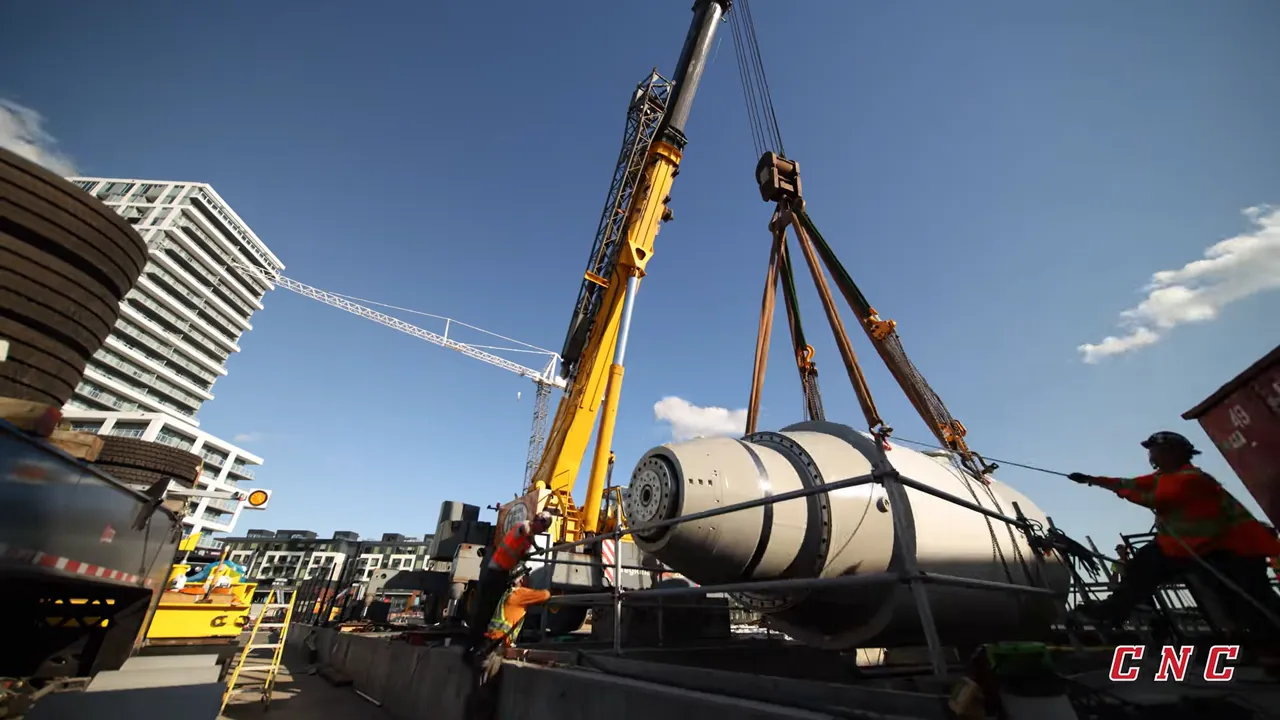
- Rigging. The unit was rigged with four Kevlar slings rated 90,000 lb and two 30-ton chain falls, the latter allowing fine adjustment of the load’s attitude.
- Lift and orientation. The turbine was lifted slowly off its steel frame, then manoeuvred over the intake deck opening.
- Controlled descent. The unit was lowered approximately 80 feet into the opening while alignment was held against a clearance of less than 1/8 in.
Receiving the unit and installing it were both finished the same day, which was the first milestone of the mandate on this site.
What the technical partner says
John Spithoff, site manager at Andritz Hydro, was on site during the work. He has been with Andritz for more than 15 years as a site technical adviser and site manager, and has worked with CNC Mechanical on multiple projects:
“They’re a very professional team. They know what they got to do. It makes my job a lot easier because they’ve got everything planned out. They just do their job well.”
Fred Plouffe, Director of Ontario Operations at CNC Mechanical, summed up the day by the combination this kind of mandate calls for: the task executed safely, in collaboration with Andritz Hydro and Portage Power.
What this project demonstrates
A turbine-generator replacement is not judged by crane capacity but by the quality of the planning that precedes it. On this site, preparation covered specific items: rigging selected against the geometry of the unit, crane and trailer positioning on an existing deck, the descent sequence, and the means of verifying alignment.
It is the same method CNC Mechanical applies to its other hydroelectric power mandates: rotating equipment, precision alignment and structural steel in confined spaces, in Quebec and in Ontario.
Discuss a lift or an equipment replacement
Share the site, the equipment involved, the available access and the work window. The team can then establish lift feasibility and the next steps.
Request a quote · View millwright services · View all projects